How to Crochet the Double Crochet Stitch: Easy Step-by-Step Tutorial for Beginners
FREE CROCHET TUTORIAL • BEGINNER FRIENDLY • US CROCHET TERMS
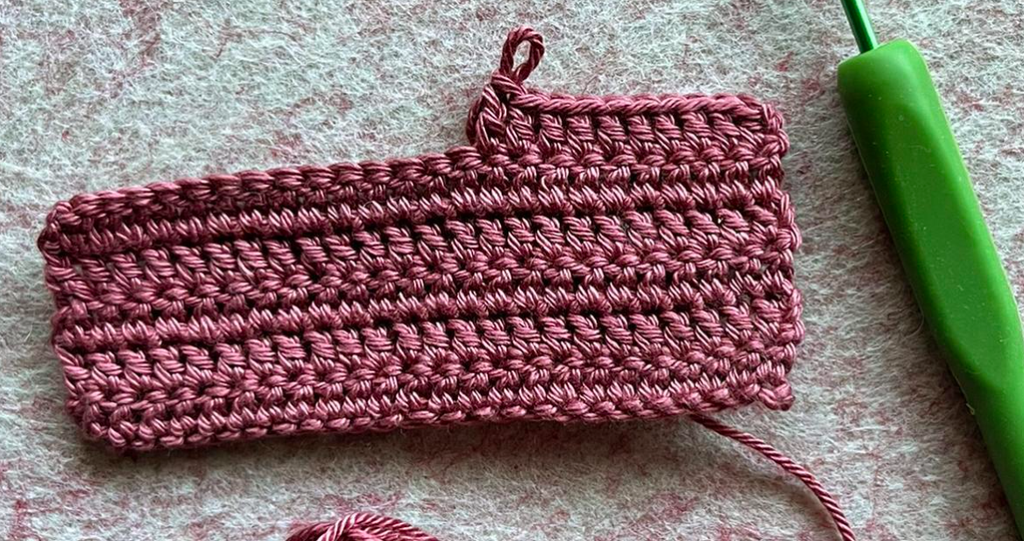
Learning the double crochet stitch is one of the most useful skills you can develop as a beginner crocheter. This simple stitch is easy to learn, works up quickly, and creates a soft, flexible fabric that you can use for blankets, scarves, sweaters, shawls, and many other handmade projects.
If you’ve recently started crocheting, you may already know how to make a slip knot and a foundation chain. The double crochet stitch is a natural next step. It is taller than a single crochet stitch, which means you can complete larger projects with fewer rows.
In this complete beginner’s guide, you’ll learn how to crochet the double crochet stitch with easy instructions, helpful pictures, accurate stitch counts, and practical tips for keeping your edges straight.
We’ll also make a small practice swatch together, explore different double crochet variations, and answer common questions that beginners often have.
By the end of this tutorial, you’ll understand how to work double crochet stitches into a foundation chain, turn your work, count stitches correctly, and use this versatile stitch in your own crochet projects.
What is the double crochet stitch?
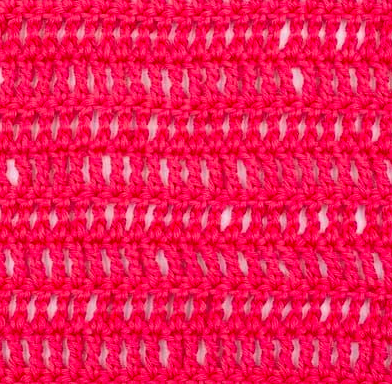
The double crochet stitch, abbreviated as dc in US crochet terminology, is a basic crochet stitch made by wrapping the yarn around your hook before inserting it into the next stitch.
Unlike single crochet, which is shorter and creates a dense fabric, double crochet produces taller stitches with a slightly more open texture.
One double crochet stitch is completed by pulling yarn through loops on your hook in two separate stages.
This creates the familiar tall, slightly twisted stitch that appears in countless crochet patterns.
Double crochet is especially popular because it offers a balance between speed, flexibility, and structure. It is suitable for both decorative and practical projects.
Why beginners should learn double crochet
There are several reasons why double crochet is worth practicing early in your crochet journey.
First, it works up relatively quickly. Because the stitches are tall, each row adds more height than a row of single crochet.
Second, double crochet is easy to recognize once you become familiar with its appearance. This makes counting stitches and identifying mistakes much easier with practice.
Third, it is the foundation for many other crochet techniques, including granny squares, shell stitches, V-stitches, and textured patterns.
Finally, double crochet is versatile. You can use it with lightweight yarn for airy shawls or thicker yarn for warm blankets and cozy accessories.
Materials you’ll need
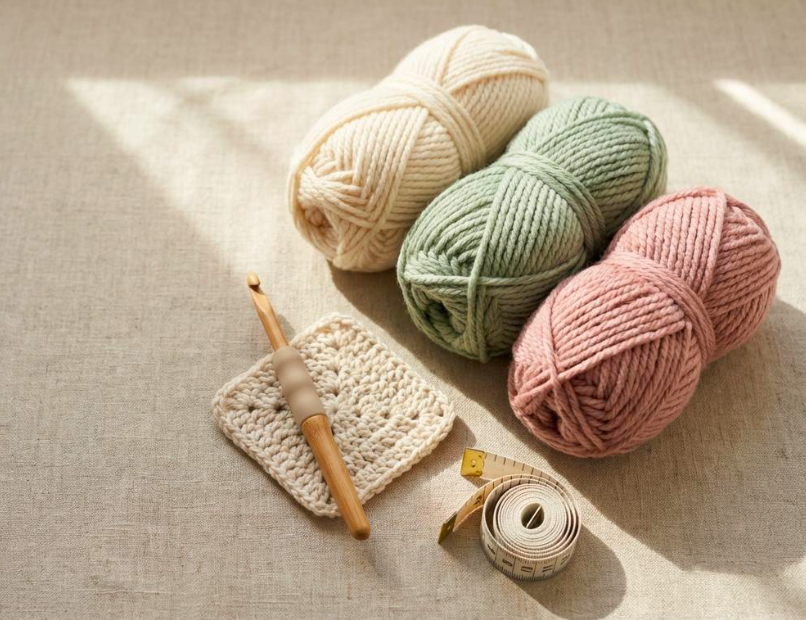
You only need a few basic supplies to learn the double crochet stitch.
| Material | Recommendation |
|---|---|
| Yarn | Worsted weight, Category 4 |
| Crochet hook | 5.0 mm (H/8) |
| Scissors | Small, sharp craft scissors |
| Yarn needle | Blunt tapestry needle |
| Stitch markers | Optional, for marking edge stitches |
| Measuring tape | For checking swatch dimensions |
For this tutorial, I recommend using a smooth, medium-weight yarn in a light or pastel color.
Light-colored yarn makes it easier to see individual stitches, especially when you’re learning where to insert your hook.
Avoid fuzzy, highly textured, or very dark yarn for your first practice project. These yarns can make the stitch structure difficult to recognize.
A comfortable crochet hook is equally important. A 5.0 mm hook is a good starting point for many worsted-weight yarns, although you should always check your yarn label for recommendations.
Crochet abbreviations (US terms)
Before we begin, here are the abbreviations you’ll see throughout the instructions.
| Abbreviation | Meaning |
|---|---|
| ch | Chain |
| dc | Double crochet |
| sc | Single crochet |
| sl st | Slip stitch |
| st(s) | Stitch(es) |
| rep | Repeat |
| YO | Yarn over |
| FO | Fasten off |
| RS | Right side |
| WS | Wrong side |
Important: This article uses US crochet terminology. In UK crochet terminology, the US double crochet stitch is called a treble crochet.
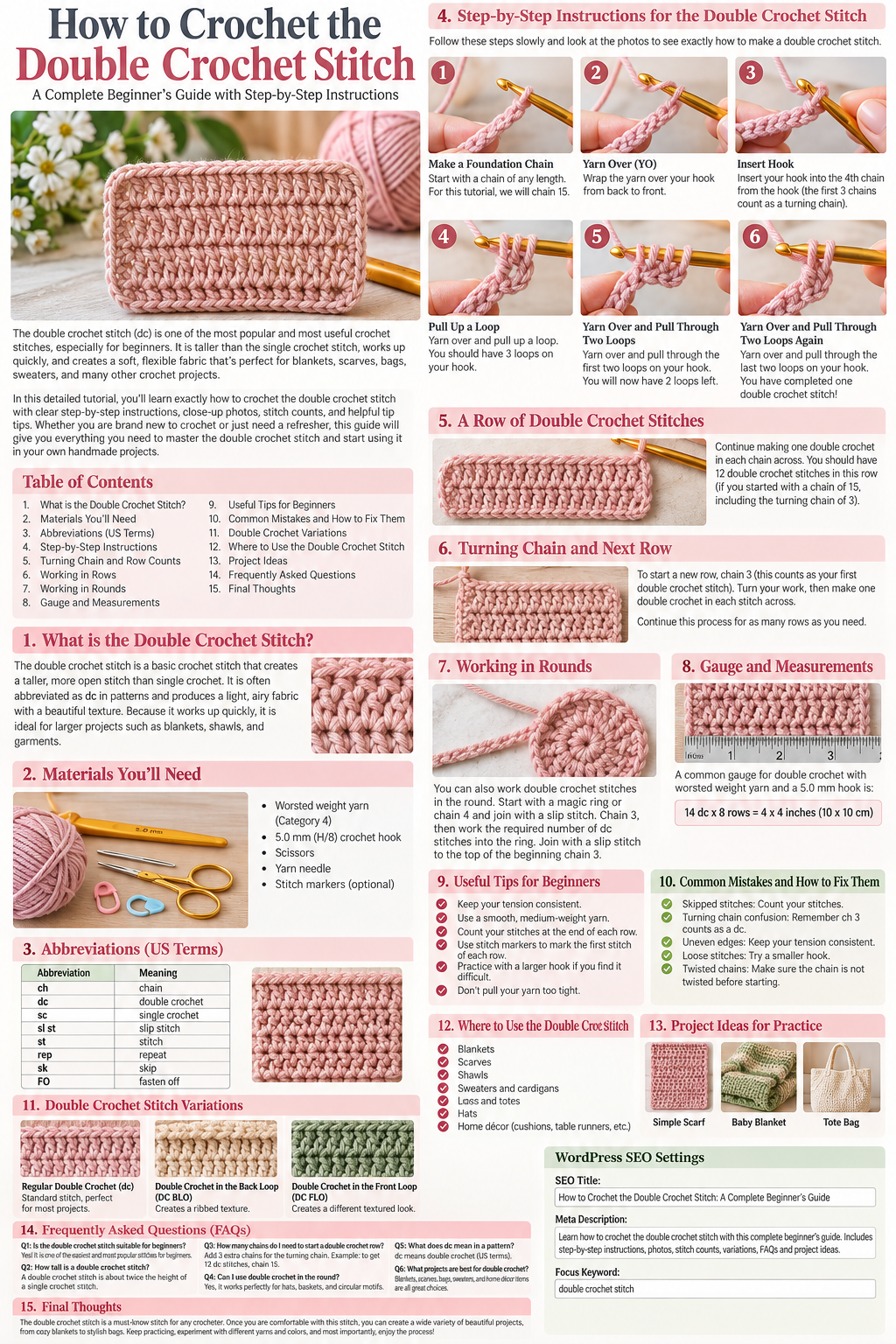
How to double crochet: Step-by-step instructions
The double crochet stitch follows a simple sequence. Once you understand the movement, you can repeat it to create rows of beautiful, even stitches.
For our beginner practice swatch, we will make 12 double crochet stitches in each row.
We’ll use a starting chain of 14 and a chain-2 turning method that does not count the turning chain as a stitch.
Step 1: Make a slip knot and foundation chain
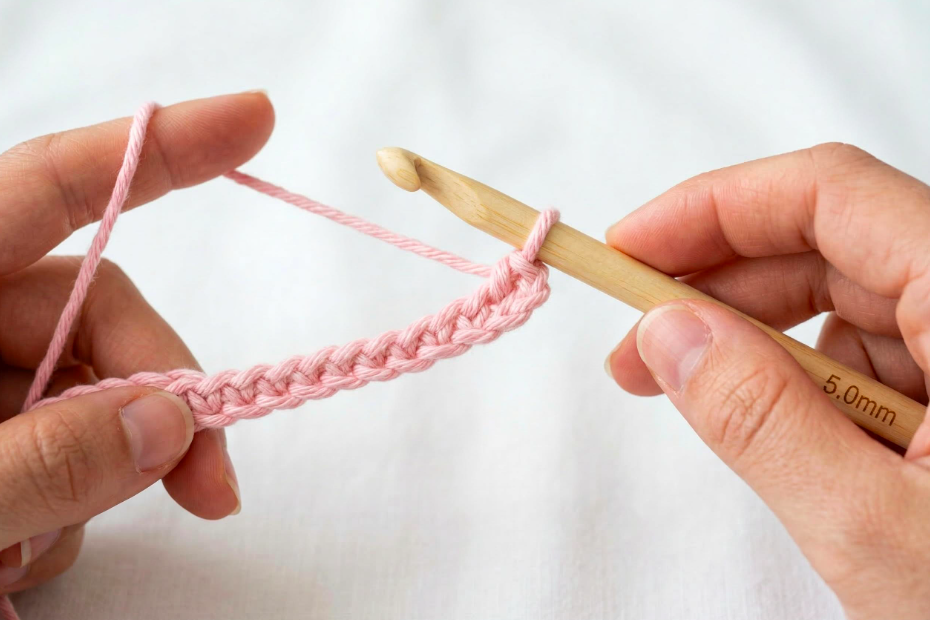
Begin by making a slip knot and placing it onto your crochet hook.
Hold the hook comfortably in your dominant hand and control the working yarn with your other hand.
Yarn over your hook and pull the yarn through the loop to create your first chain stitch.
Repeat this movement until you have made 14 chains.
Try to keep the chains even and relaxed. If you pull the yarn too tightly, inserting your hook into the foundation chain will become difficult.
Remember that the loop currently on your hook does not count as a chain stitch.
Step 2: Yarn over your hook
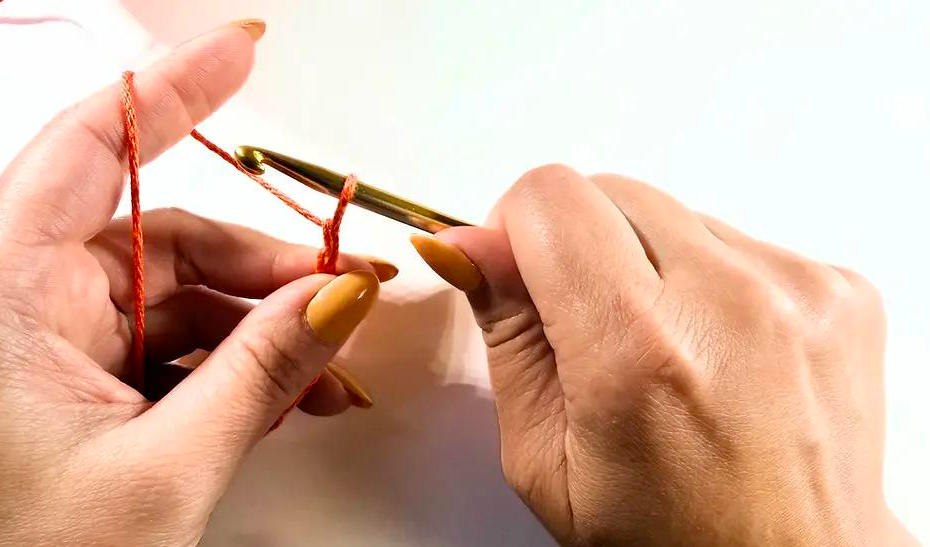
Before inserting your hook into the foundation chain, wrap the working yarn over the hook once.
This movement is called a yarn over, often abbreviated as YO.
The yarn over is what gives the double crochet stitch its extra height.
Keep the yarn comfortably tensioned without pulling it too tightly.
Step 3: Insert your hook into the third chain
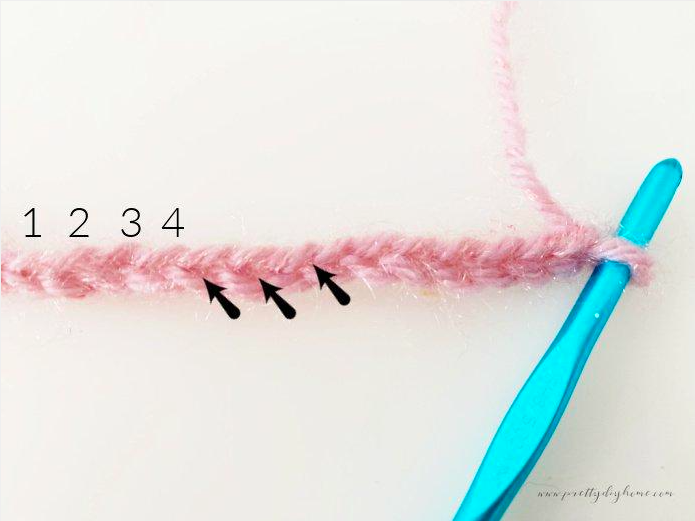
Count three chains backward from your hook.
Do not count the loop currently sitting on the hook.
Insert your hook into the third chain.
Because our turning chain does not count as a stitch, this will become the first double crochet stitch of the row.
For this 14-chain practice swatch, working into the third chain leaves 12 chains available for double crochet stitches.
Step 4: Yarn over and pull up a loop
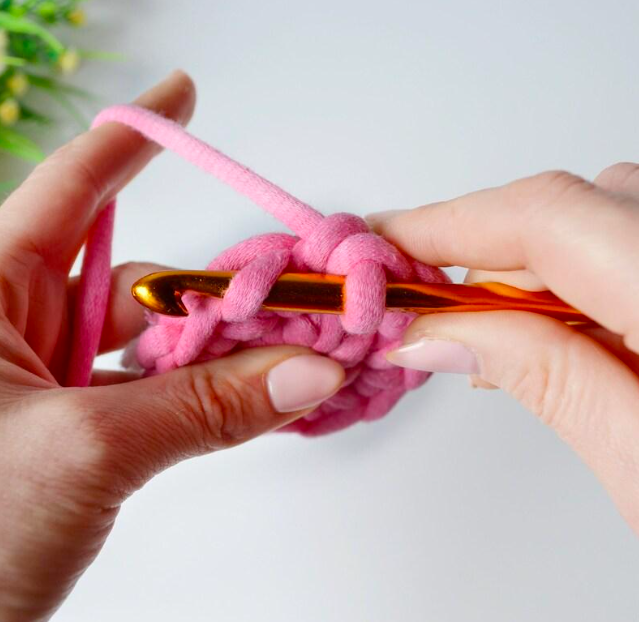
With your hook inserted into the chain, yarn over again.
Pull the yarn back through the chain stitch.
You should now have three loops on your crochet hook.
This is an important checkpoint. If you have fewer or more than three loops, check whether you accidentally skipped a yarn over or wrapped the yarn around your hook more than once.
Step 5: Yarn over and pull through two loops
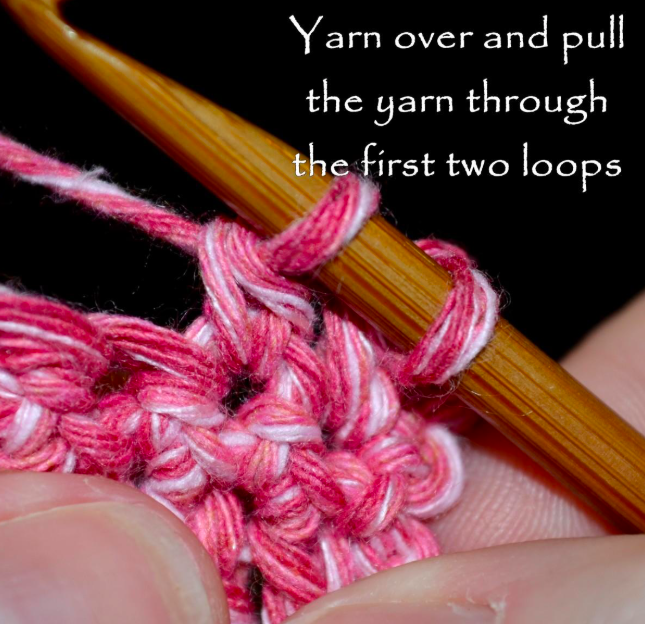
Yarn over your hook once more.
Carefully pull the yarn through the first two loops on your hook.
You should now have two loops remaining.
Try to move the hook smoothly rather than pulling forcefully.
If the loops feel too tight, relax your grip and allow a little more yarn to move through your fingers.
Step 6: Yarn over and pull through the final two loops
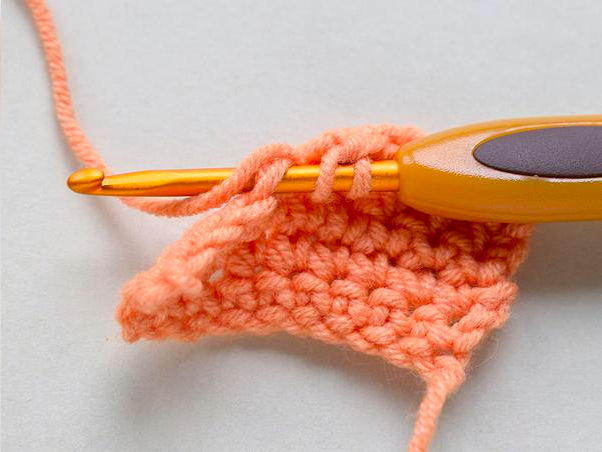
Yarn over again and pull through both remaining loops.
You should now have only one loop left on your hook.
Congratulations! You’ve completed your first double crochet stitch.
The entire double crochet sequence is:
Yarn over → Insert hook → Pull up a loop → Yarn over and pull through 2 → Yarn over and pull through 2.
This same sequence is repeated for every regular double crochet stitch.
How to crochet your first full row
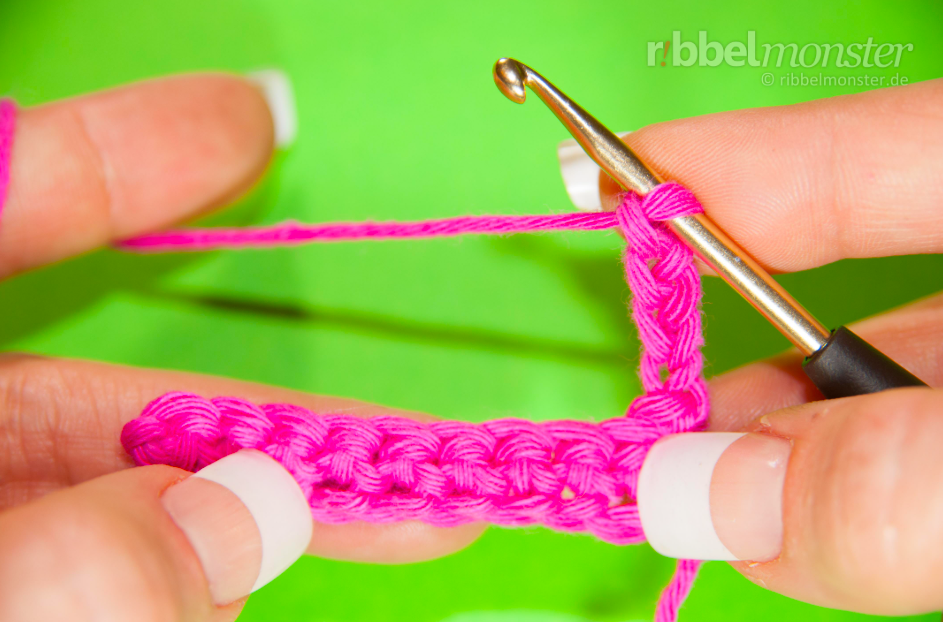
Now that you’ve completed your first stitch, continue working across the foundation chain.
Yarn over, insert your hook into the next chain, and repeat the double crochet sequence.
Continue until you’ve worked into every remaining chain.
At the end of the row, you should have exactly 12 double crochet stitches.
Count the stitches by identifying the V-shaped tops along the upper edge of your work.
Each double crochet stitch has one V-shaped top. The turning chain at the beginning does not count as a stitch in this tutorial.
If you have 11 or 13 stitches instead of 12, check the foundation chain carefully. Beginners sometimes miss the final chain or accidentally work twice into the same chain.
How to turn your work for the next row
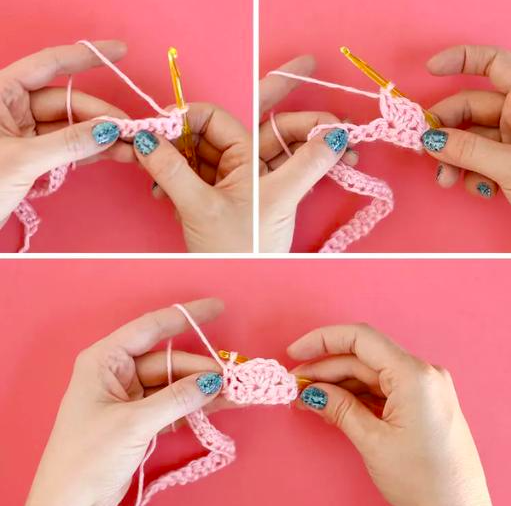
Once you’ve finished the first row, you’ll need to turn your work to begin the next row.
Chain 2, then turn your crochet piece so that you can work back across the previous row.
Remember that this chain 2 does not count as a double crochet stitch in our pattern.
Work your first double crochet into the very first stitch.
Continue working one double crochet into each stitch across the row.
At the end of Row 2, you should still have 12 double crochet stitches.
Using this method consistently helps maintain straight edges and accurate stitch counts.
Some crochet patterns use a chain-3 turning chain that counts as the first double crochet stitch. That method is also valid, but the two methods should not be mixed without adjusting stitch placement.
For this beginner tutorial, we’ll continue using chain 2 without counting it as a stitch.
Free double crochet practice swatch pattern
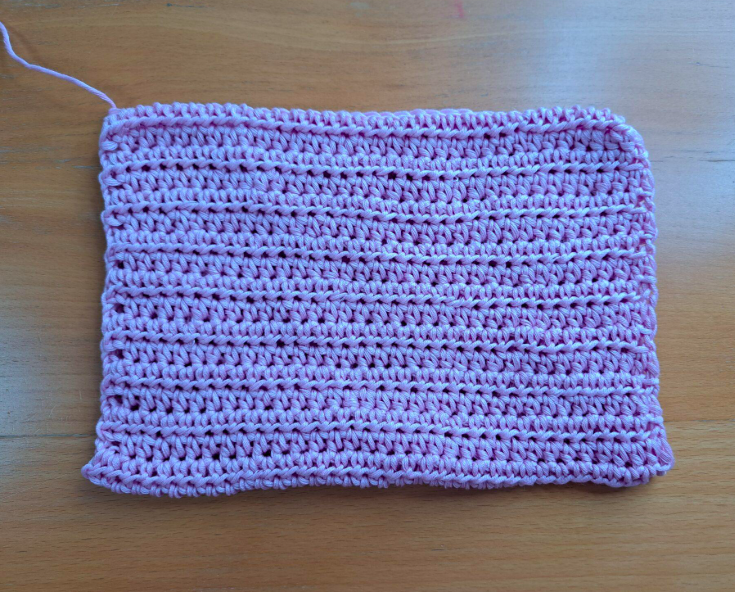
Now let’s put everything together into a small practice project.
This swatch is designed to help you practice stitch placement, turning chains, tension, and counting.
Pattern instructions
Foundation: Ch 14.
Row 1: Dc in the third chain from the hook and in each chain across. (12 dc)
Row 2: Ch 2, turn. Dc in the first stitch and in every stitch across. (12 dc)
Row 3: Ch 2, turn. Dc in each stitch across. (12 dc)
Row 4: Repeat Row 3. (12 dc)
Row 5: Repeat Row 3. (12 dc)
Row 6: Repeat Row 3. (12 dc)
Row 7: Repeat Row 3. (12 dc)
Row 8: Repeat Row 3. (12 dc)
Row 9: Repeat Row 3. (12 dc)
Row 10: Repeat Row 3. (12 dc)
After Row 10, fasten off and leave a yarn tail approximately 6 inches long.
Thread the tail through a yarn needle and weave it securely into the back of your swatch.
Your finished piece should have 10 rows and 12 double crochet stitches per row, for a total of 120 double crochet stitches.
The exact dimensions will depend on your yarn and tension.
This little swatch is an excellent practice project because you can easily spot uneven edges, missed stitches, or changes in tension.
Understanding double crochet gauge
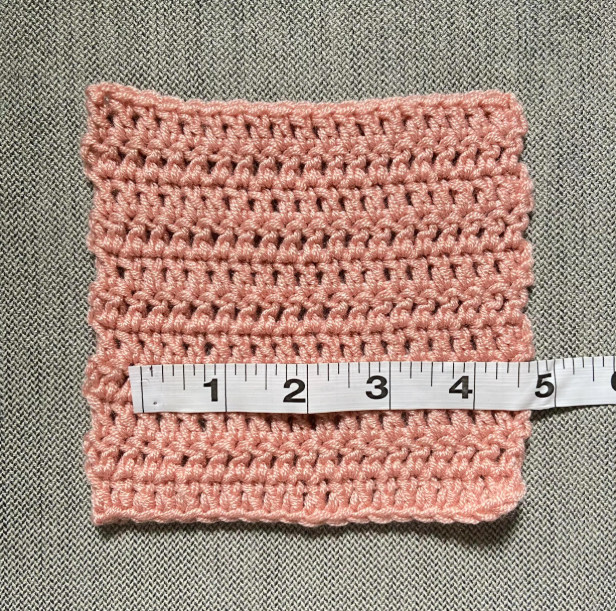
Gauge refers to the number of stitches and rows you make within a particular measurement, usually 4 inches or 10 centimeters.
For example, a possible gauge for worsted-weight yarn and a 5.0 mm hook is:
14 double crochet stitches × 8 rows = 4 × 4 inches (10 × 10 cm).
This is an example gauge, not a guaranteed measurement for every crocheter.
Your personal tension, yarn brand, and hook style can all affect the result.
To check gauge, make a swatch larger than 4 inches in both directions. Lay it flat without stretching and count the stitches and rows within a central 4-inch section.
If you have more stitches than the target gauge, your stitches are smaller, so you may need a larger hook.
If you have fewer stitches, your stitches are larger, so you may need a smaller hook.
Gauge matters most when making fitted garments or projects that require precise measurements. For a beginner practice swatch, consistency is more important than matching a particular size.
How to count double crochet stitches correctly
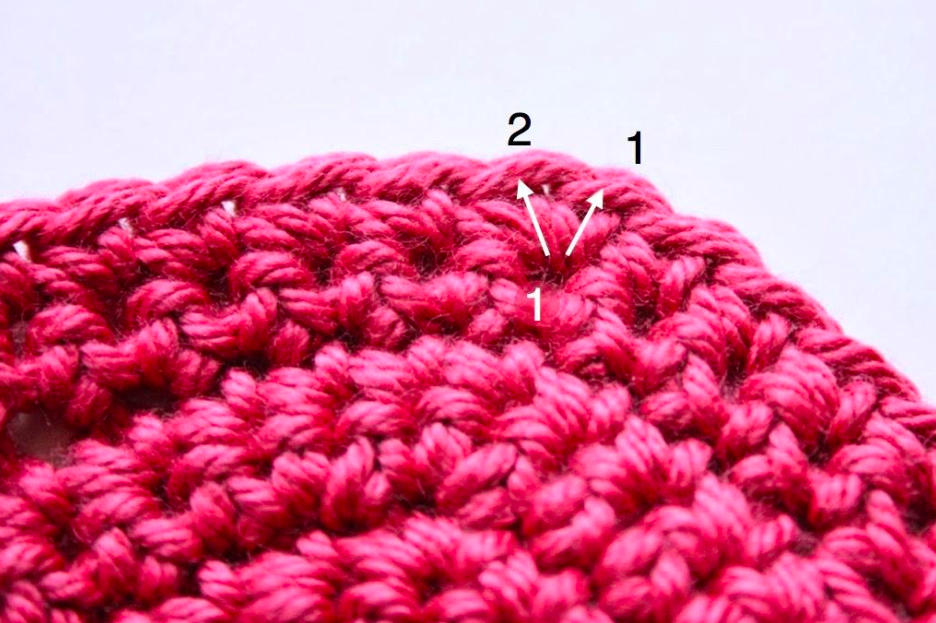
Counting stitches correctly is one of the most important habits you can develop as a beginner.
When you look at the top of a completed double crochet row, you’ll notice a series of small V-shaped loops. Each V represents one completed stitch.
To count your stitches, start at one side of the row and move across, counting each V individually.
For our practice swatch, every row should contain 12 double crochet stitches.
The chain-2 turning chain does not count as a stitch, so don’t include it when counting.
If you’re having trouble recognizing the first or last stitch, place a stitch marker in each edge stitch as you work.
Stitch markers are especially helpful when you’re making larger projects because they prevent accidental increases or decreases.
How to keep double crochet edges straight
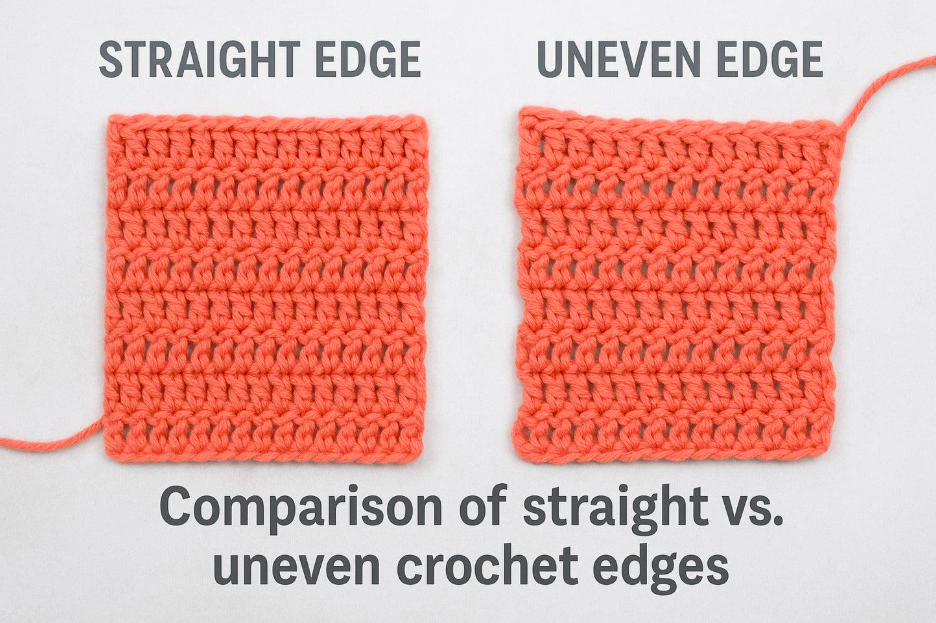
Uneven edges are one of the most common challenges for new crocheters.
Fortunately, they are usually caused by small mistakes that are easy to correct.
The first mistake is skipping the first stitch after turning your work. In this tutorial, the chain-2 turning chain does not count as a stitch, so you must work into the first actual stitch.
Another common mistake is accidentally adding a stitch at the end of a row by crocheting into the turning chain.
You can avoid this by identifying the last true stitch before beginning each row.
Tension also affects the appearance of your edges. If your turning chains are too tight, the sides may pull inward. If they’re too loose, you may notice small gaps.
Try to maintain a comfortable, consistent tension and count your stitches after every row until the process becomes familiar.
How to work double crochet in the round
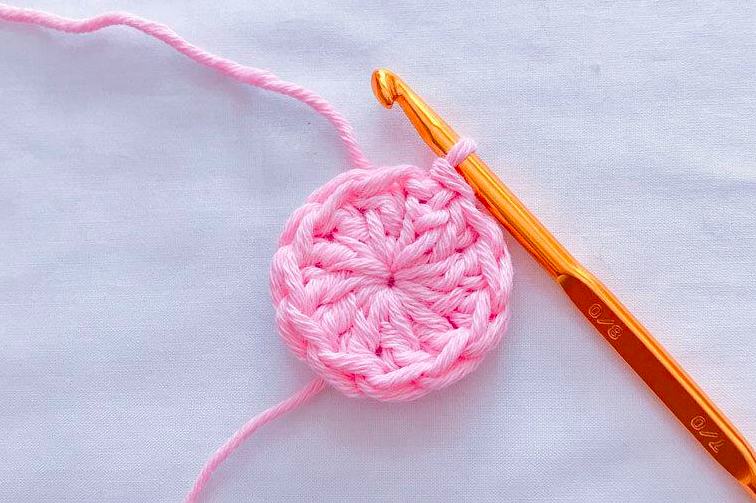
Double crochet isn’t limited to straight rows. You can also work it in circles, which is useful for hats, round blankets, baskets, and decorative motifs.
Here’s a simple practice circle using double crochet stitches.
Round 1: Make a magic ring. Ch 3 (counts as your first dc). Work 11 dc into the ring. Pull the ring closed and join with a sl st to the top of the beginning ch 3. (12 dc)
Round 2: Ch 3 (counts as the first dc), then work 1 dc into the same stitch. Work 2 dc into each remaining stitch around. Join with a sl st to the top of the beginning ch 3. (24 dc)
Round 3: Ch 3 (counts as the first dc), work 1 dc into the same stitch, then work 1 dc into the next stitch. Repeat 2 dc in the next stitch, 1 dc in the following stitch around. Join with a sl st to the beginning ch 3. (36 dc)
For this circular example, the beginning chain 3 counts as a double crochet stitch. This is different from the chain-2 turning method used for our flat practice swatch.
You can continue expanding a flat double crochet circle by increasing evenly around each round. The number of stitches between increases generally grows as the circle becomes larger.
If your circle starts to ripple, you may have too many stitches or your gauge may be too loose. If it curls into a bowl shape, you may need more increases.
Three easy double crochet stitch variations
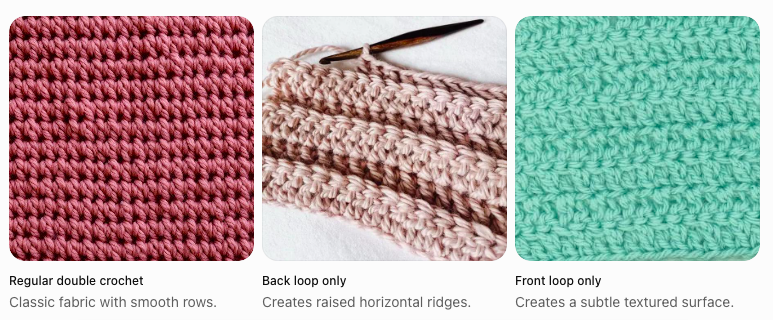
Once you’re comfortable making regular double crochet stitches, try experimenting with where you insert your hook.
These simple variations create different textures without requiring you to learn an entirely new stitch.
1. Regular double crochet
Regular double crochet is worked through both loops at the top of each stitch.
This creates a classic, even fabric that is suitable for blankets, scarves, shawls, and garments.
2. Back loop only double crochet
Back loop only double crochet, often abbreviated as BLO dc, is worked through only the back loop of the V-shaped stitch.
Instead of inserting your hook under both loops, insert it under the loop farthest from you.
This technique creates horizontal ridges that can add texture to blankets, scarves, and decorative accessories.
3. Front loop only double crochet
Front loop only double crochet, or FLO dc, is worked through the front loop of the stitch.
Insert your hook under the loop closest to you, then complete the double crochet stitch normally.
This variation creates a different texture and can be useful for decorative stitch patterns.
Double crochet vs. single crochet vs. half double crochet
Beginners sometimes confuse these three basic stitches because their movements are similar.
Here’s a simple comparison.
| Stitch | Height | Fabric texture | Typical use |
|---|---|---|---|
| Single crochet (sc) | Short | Dense, firm | Amigurumi, baskets |
| Half double crochet (hdc) | Medium | Soft, moderately dense | Hats, garments |
| Double crochet (dc) | Tall | Flexible, more open | Blankets, scarves, shawls |
Single crochet is worked without an initial yarn over. Half double crochet begins with a yarn over but finishes by pulling through all three loops at once.
Double crochet begins with a yarn over and is completed in two pull-through stages.
Understanding these differences will make it easier to follow patterns that combine several stitch types.
Common double crochet mistakes and how to fix them
Even experienced crocheters occasionally make mistakes. The important thing is learning how to recognize and correct them.
Mistake 1: Skipping the last stitch
This can cause your project to become narrower with each row.
Solution: Place a stitch marker in the final stitch of each row and count your stitches before turning.
Mistake 2: Adding an extra stitch
This often happens when you accidentally crochet into the turning chain.
Solution: Remember that the chain-2 turning chain does not count as a stitch in our swatch pattern.
Mistake 3: Pulling the yarn too tightly
Tight tension can make it difficult to insert your hook and may create stiff, uneven fabric.
Solution: Relax your grip, adjust how you hold the working yarn, and consider trying a slightly larger hook.
Mistake 4: Uneven stitch height
Some stitches may appear taller or shorter than others when your tension changes.
Solution: Practice making several rows at a comfortable pace. Focus on smooth, consistent movements rather than speed.
Mistake 5: Splitting the yarn
If your hook catches only part of the yarn strand, the finished stitch may look messy.
Solution: Use a smooth yarn, check your hook placement, and avoid forcing the hook through tight stitches.
What can you make with the double crochet stitch?
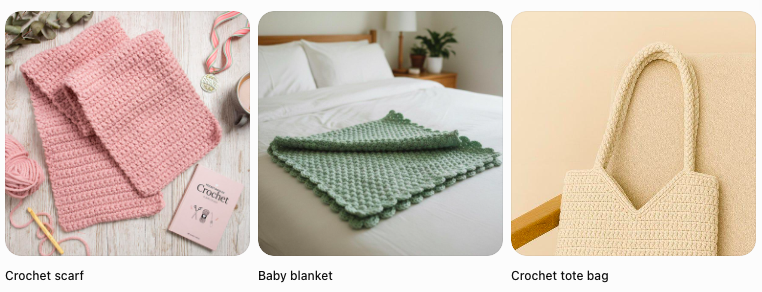
Once you’ve mastered double crochet, you can use it to make many different projects.
A simple scarf is a great first project because you can work back and forth in rows without worrying about complicated shaping.
Blankets are another popular option. Double crochet works up relatively quickly, making it useful for larger projects.
You can also make lightweight shawls, cardigans, cushion covers, and decorative home accessories.
For bags, double crochet can create an attractive fabric, although it may need a lining or reinforcement because the stitches have more space between them than single crochet.
As your confidence grows, you can combine double crochet with other stitches to create beautiful textured patterns.
Helpful tips for beginners
If you’re new to crochet, don’t worry about making every stitch perfect immediately.
Crochet is a skill that improves with repetition, and your hands will gradually become more comfortable with the movements.
Start with short practice sessions. Even 15–20 minutes of focused practice can help you develop better control over your yarn and hook.
Use a light-colored yarn so you can see where each stitch begins and ends.
Count your stitches regularly, especially when you’re learning to turn your work.
If you notice a mistake several rows back, decide whether it affects the overall structure before undoing your work. Some minor imperfections are purely cosmetic, while missed stitches can change the shape of a project.
Most importantly, give yourself time to learn. A consistent double crochet stitch is much more valuable than rushing through a project.
Frequently asked questions about the double crochet stitch
Is the double crochet stitch easy for beginners?
Yes. Double crochet is one of the basic crochet stitches and is suitable for beginners who have learned how to make a slip knot and foundation chain.
The stitch follows a repetitive sequence that becomes easier with practice.
How many chains do I need to start a double crochet row?
That depends on the turning-chain method used by your pattern.
Some patterns use chain 3 and count it as the first double crochet. Others use chain 2 without counting it as a stitch.
For the practice swatch in this article, chain 14 to create 12 double crochet stitches in Row 1, then use chain 2 to turn subsequent rows.
Why does my double crochet have gaps?
Double crochet is taller than single crochet, so small spaces between stitches are normal.
Larger gaps can occur when your turning chain is too loose or your tension is inconsistent.
Is double crochet faster than single crochet?
Double crochet often works up faster in terms of fabric height because each stitch is taller.
However, the actual speed depends on your experience, yarn, hook, and project.
How do I know where to insert my hook?
For regular double crochet rows, insert your hook under both loops of the V-shaped stitch from the previous row.
When working into a foundation chain, insert the hook into the chain specified by the pattern.
Can I use double crochet for a baby blanket?
Yes. Double crochet is commonly used for baby blankets because it creates a soft and flexible fabric.
Choose an appropriate yarn, maintain secure stitches, and avoid loose embellishments or other details that could present hazards to infants.
What is the difference between US and UK double crochet?
In US terminology, double crochet is a tall stitch made with an initial yarn over and two pull-through stages.
In UK terminology, the term double crochet refers to the stitch called single crochet in the US.
Always check which terminology your pattern uses before starting.
Why is my double crochet project getting wider?
Your project may be getting wider because you’re accidentally adding stitches at the beginning or end of rows.
Count your stitches after each row and follow the turning-chain instructions consistently.
Can I crochet double crochet stitches with chunky yarn?
Yes. Double crochet works with many yarn weights, including chunky yarn.
Use a hook size appropriate for the yarn and remember that thicker yarn will create larger stitches and a heavier fabric.
How long does it take to learn double crochet?
Many beginners understand the basic movement within a short practice session, but developing even tension and consistent stitch counts can take longer.
Practice regularly, and you’ll gradually become more comfortable with the technique.
Final thoughts
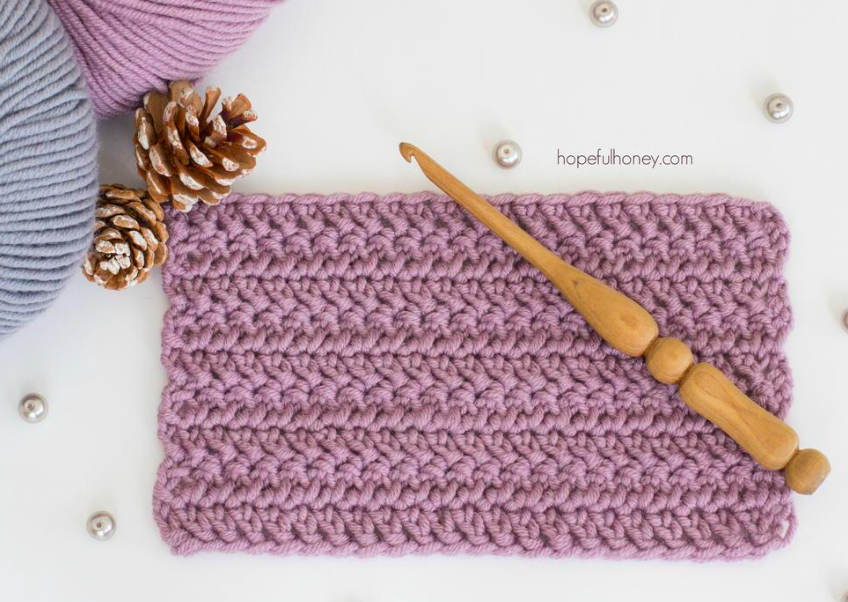
The double crochet stitch is a fundamental crochet technique that opens the door to countless handmade projects.
Once you understand how to yarn over, pull up a loop, and complete the two pull-through stages, you can use this stitch to make everything from simple scarves to beautiful blankets and garments.
Start with the small practice swatch in this tutorial. Focus on keeping 12 stitches in each row, maintaining comfortable tension, and making your edges as straight as possible.
Don’t worry if your first few rows look uneven. With practice, your stitches will become more consistent, and the process will begin to feel natural.
When you’re ready, try experimenting with different yarn colors, hook sizes, and double crochet variations.
Every project you complete will help you build confidence and develop your crochet skills.
Happy crocheting!